Skyde — Your smart flight companion
A proactive aviation companion that guides passengers before, during, and after flight disruptions. Instead of feeling overwhelmed, travelers feel guided.
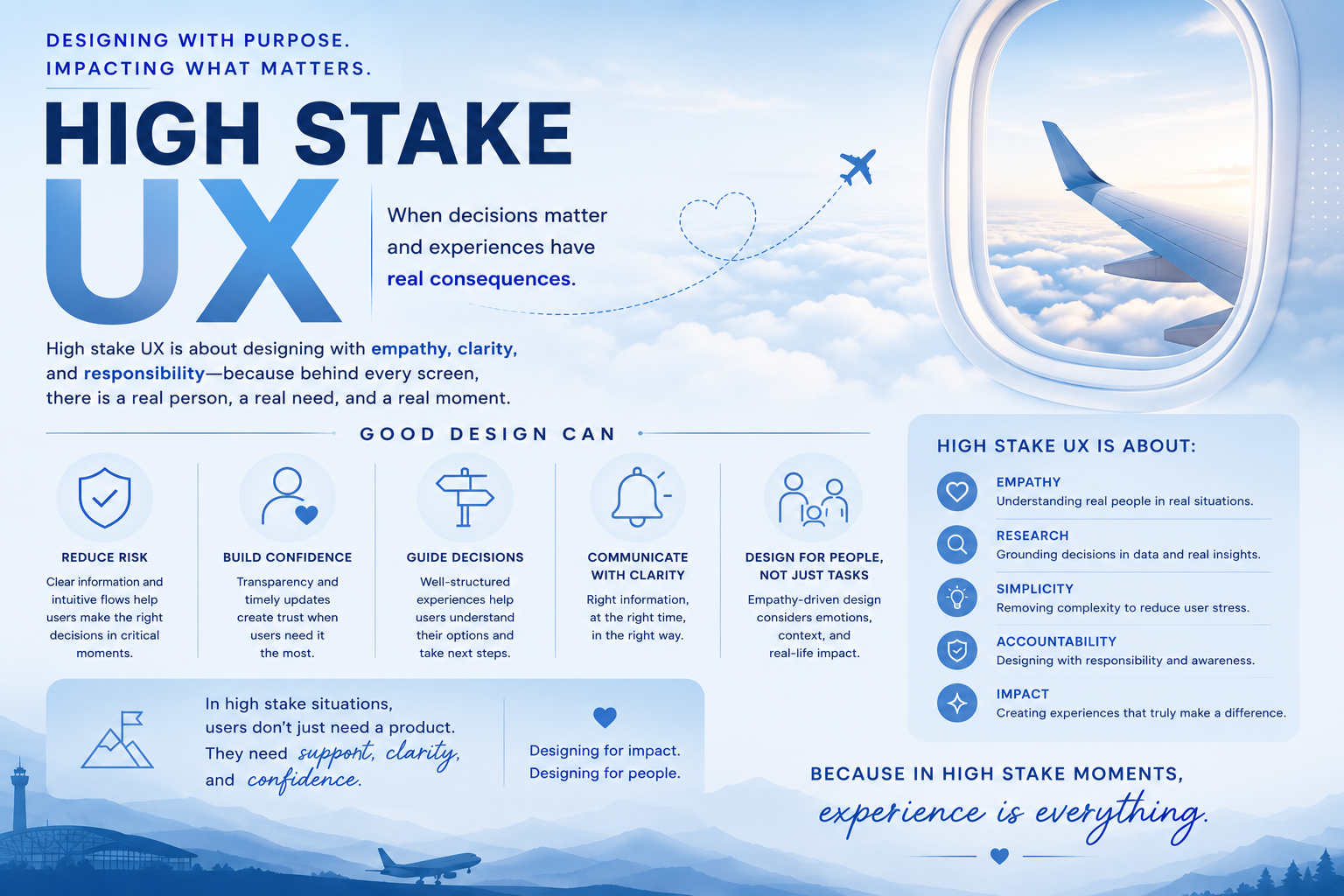
S — Situation
Air travel disruptions are one of the biggest sources of passenger anxiety. Through interviews with frequent travelers and aviation professionals, we discovered that passengers often struggle with:
- Lack of timely and trustworthy information
- Uncertainty about what to do next
- Poor understanding of airline policies and passenger rights
- Difficulty informing family members during disruptions
- Switching between multiple apps (airline, maps, email, messaging)
Problem statement
How might we reduce passenger stress during flight disruptions by providing clear, timely, and actionable guidance throughout the journey?
T — Task
Design a mobile application that acts as a personal travel assistant. It needed to:
- Reduce passenger anxiety
- Deliver proactive updates instead of reactive notifications
- Guide users step-by-step during disruptions
- Improve confidence throughout the travel journey
- Consolidate essential travel information into one place
A — Action
1. Research
Qualitative research with frequent flyers, aviation professionals, airport operations, and airline staff.
- Users constantly refresh airline apps because updates feel unreliable
- Many travelers don't know their rights during delays
- Passengers often don't know the next action to take
- Families become anxious when communication is delayed
- Travelers use 4–6 different apps during a single journey
2. Defined opportunity
We reframed the challenge: passengers don't need more information — they need better guidance. That shifted the design direction from information delivery to decision support.
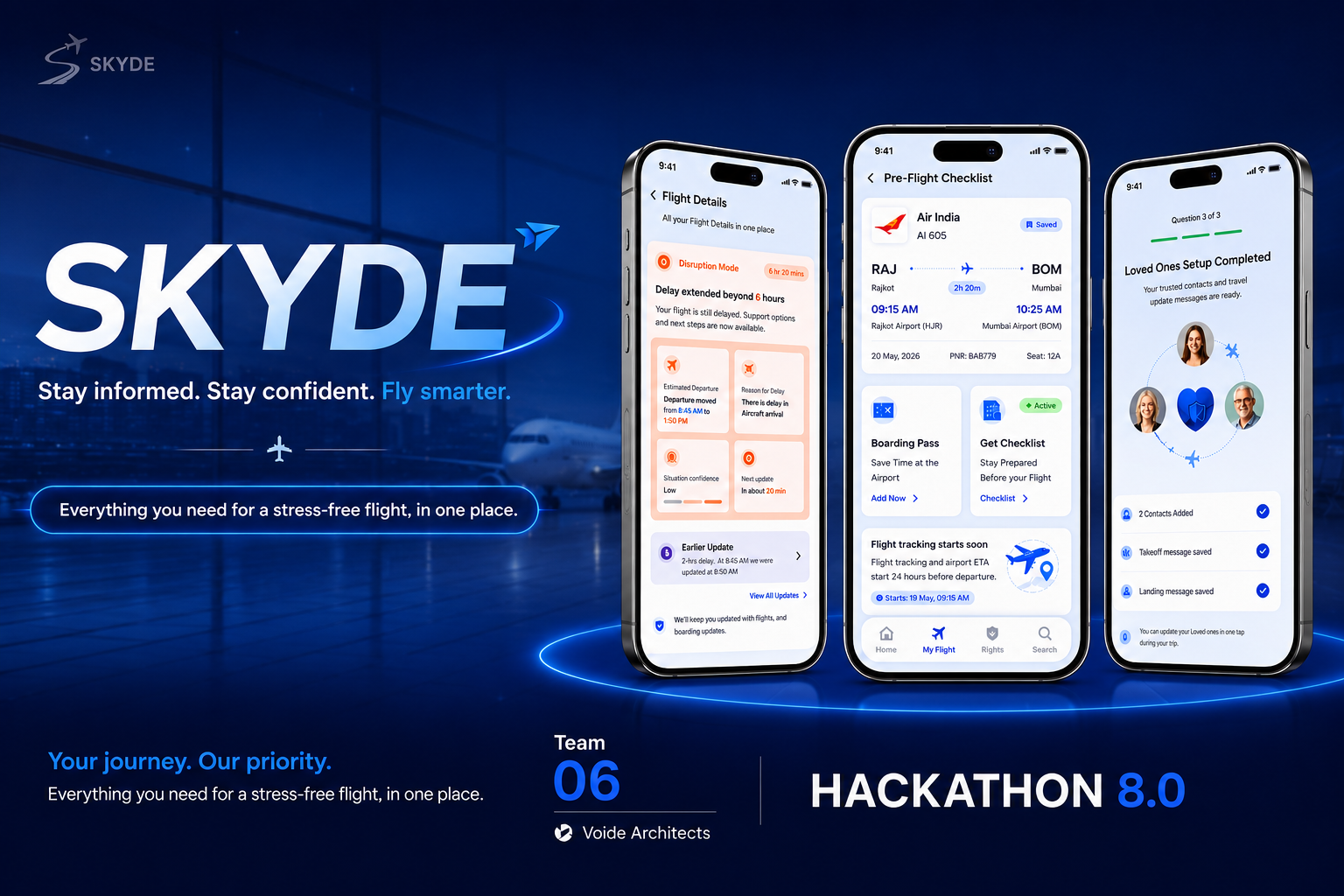
3. Core features — Pre-flight checklist
- Travel document reminders
- Boarding pass management
- Airport guidance
- Baggage checklist
- Flight readiness tracker
Disruption mode
The core innovation of Skyde. When a disruption occurs, Skyde automatically explains the reason, shows expected departure updates, recommends the next best action, surfaces passenger rights, displays confidence levels for updates, and maintains a timeline of notifications. Instead of asking "what happened?" users immediately know "what should I do next?"
Loved ones setup
Passengers preconfigure trusted contacts. Skyde automatically shares takeoff confirmation, landing confirmation, and delay notifications — reducing anxiety for both passengers and families.
Passenger rights
Contextual information about meal eligibility, hotel accommodation, compensation, and airline assistance — surfaced only when relevant.
Flight timeline
Updates organized chronologically so users understand the progression of events instead of parsing isolated notifications.
4. Design principles
- Clarity over complexity
- Progressive disclosure
- Reduced cognitive load
- Calm visual language
- Trust through transparency
- Action-oriented communication
5. UI decisions
- White cards for readability
- Aviation-inspired blue palette
- Clear information hierarchy
- Large touch targets
- Minimal visual noise
- Status indicators with contextual colors
- Card-based modular layout
R — Result
Designed a working concept within the 60-day hackathon, presenting a complete end-to-end passenger journey to judges and receiving positive feedback for addressing a real aviation pain point.
Judges appreciated
- Clear interface design
- Strong visual consistency
- Practical disruption-management features
Areas for improvement
- Strengthen storytelling to communicate the user's emotional journey
- Expand the "action layer" with more personalized guidance and contextual recommendations during disruptions
History
Every journey begins long before takeoff. Air travel has become more connected than ever, yet passengers continue to experience fragmented information. During delays and disruptions, they switch between airline apps, messaging platforms, airport displays, emails, and web searches to understand what is happening. Our research showed that the problem wasn't the absence of information — it was the absence of guidance. Skyde was born from a simple observation: passengers don't panic because flights are delayed; they panic because they don't know what to do next. Instead of building another flight-tracking application, we envisioned a digital companion that stays with passengers throughout their journey.
Geography
Designing across the entire travel ecosystem. Unlike traditional airline apps that focus only on booking or check-in, Skyde supports passengers across multiple environments — Home (trip prep, document reminders, packing checklist), Airport (navigation, boarding updates, gate changes), During Disruptions (delay explanations, passenger rights, alternative actions) and Destination (arrival updates, loved-one notifications, journey completion). The product had to perform equally well in calm environments and in high-stress situations where attention is limited.
Physics
Every system has constraints. Air travel operates within complex operational realities: flight status latency, airline operational dependencies, limited passenger attention, poor airport connectivity, and high cognitive load during disruptions. Instead of fighting these limitations, we designed around them. Rather than promising real-time certainty, Skyde communicates confidence levels and update timelines, helping users understand when new information is expected.
Chemistry
Where people, systems, and intelligence interact. The most important interaction wasn't between a user and a button — it was between passenger, operational data, and actionable guidance. Instead of showing "Flight Delayed," Skyde explains why the delay occurred, what it means, what passengers should do next, and whether they're eligible for assistance. The interface reacts to changing situations instead of forcing users to interpret raw information.
Biology
Designing for human behavior. Passengers don't behave like ideal users — they refresh screens, call family, become anxious after silence, miss announcements, and overlook notifications. Rather than designing for perfect behavior, Skyde supports natural habits: Disruption Mode reduces uncertainty through guided actions, Loved Ones Setup automatically informs trusted contacts during key milestones, and Passenger Rights are displayed only when relevant to reduce cognitive overload. The interface prioritizes reassurance before efficiency.
Mathematics
Measuring confidence instead of clicks. Traditional metrics — screen views, session duration, notification opens — don't indicate whether passengers actually feel informed. For Skyde, success is measured through experience-focused metrics: time taken to understand the next action, reduction in passenger uncertainty, support calls avoided, pre-flight checklist completion rate, engagement with disruption guidance, and a passenger confidence score. The goal wasn't engagement — it was reducing stress.
Design Engineering
Building trust through consistency. The interface was intentionally designed to feel calm. Principles: information over decoration, progressive disclosure, large touch targets, card-based layout, clear hierarchy, and aviation-inspired visual language. Motion guides attention rather than creating spectacle. Components include Flight Status Cards, Timeline Cards, Passenger Rights Modules, Boarding Components, and Notification Components. Every design decision supports one objective — reduce cognitive load during stressful moments.
Transformation
From uncertainty to confidence. Before Skyde: multiple apps, information overload, passenger confusion, unclear next steps, anxiety. After Skyde: one trusted companion, guided disruption support, passenger rights explained, family automatically informed, clear next actions, and increased confidence. The strongest insight wasn't about UI — it was about human psychology. Passengers don't expect airlines to eliminate delays; they expect someone to guide them through uncertainty. That became Skyde's core philosophy — Stay informed. Stay confident. Fly smarter.